Dripping Marker 2.0: A Practical Evaluation of the Updated Display Font
In the landscape of digital typography, display fonts often serve as the visual anchor for a design project, dictating tone and audience engagement before a single word is read. Dripping Marker 2.0 represents a significant evolution in this category, offering a hand-painted aesthetic that mimics the organic flow of liquid ink. Unlike rigid, geometric sans-serifs or traditional serifs, this typeface captures the unpredictability of marker pens on paper. The release of version 2.0 addresses previous limitations by expanding language support to include English, French, German, Italian, and Spanish, making it a more viable option for international projects. For designers, illustrators, and content creators evaluating their toolkit, understanding where this font fits—and where it does not—is essential for effective application.
Defining the Distinctive Characteristics of Dripping Marker 2.0
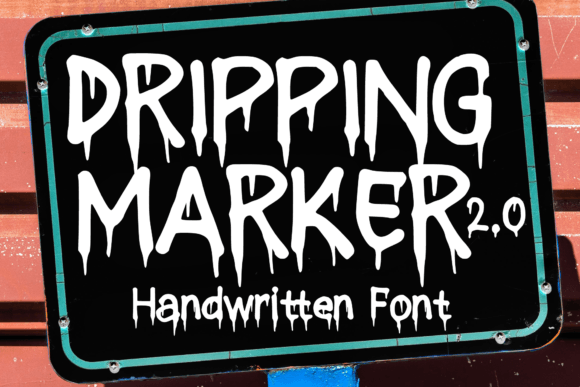
The primary appeal of Dripping Marker 2.0 lies in its ability to simulate physical media within a digital environment. The "dripping" effect is not merely an overlay but is integrated into the glyph construction, creating a sense of motion and texture. This distinguishes it from standard brush fonts, which often rely on stroke variation alone. The updated version refines these drips, ensuring they look intentional rather than messy, striking a balance between chaotic energy and legibility.
A critical improvement in this iteration is the expanded character set. Previous versions were often restricted to basic Latin characters, limiting their utility in multilingual markets. With support now extended to French, German, Italian, and Spanish, the font can handle specific diacritics and ligatures required by these languages without breaking the visual continuity. This makes Dripping Marker 2.0 particularly valuable for brands targeting European audiences or for creative projects requiring bilingual elements, such as educational materials or travel-themed merchandise.
Visual Weight and Texture
When analyzing the visual weight of the font, it becomes clear that it is designed for impact at larger sizes. The thick strokes and heavy drips provide a substantial presence, making it ideal for headlines and short phrases. However, this same characteristic can become a liability if used for body text. The texture, while charming in isolation, can create visual noise when stretched across long paragraphs, reducing readability significantly. Therefore, the font's distinctiveness is best leveraged as a focal point rather than a foundational element of a layout.
Comparing Dripping Marker 2.0 with Alternative Typography Styles
To make an informed decision, it is necessary to compare Dripping Marker 2.0 against other common categories of display fonts. In the realm of casual, hand-drawn typefaces, there are generally three approaches: clean brush scripts, grunge textures, and liquid effects. Clean brush scripts prioritize legibility and mimic the speed of writing, whereas grunge textures focus on wear and tear. Dripping Marker 2.0 occupies the niche of liquid effects, focusing specifically on the physics of wet ink.
Compared to a standard graffiti-style font, Dripping Marker 2.0 offers a softer, more approachable aesthetic. Graffiti fonts often carry connotations of rebellion or urban street culture, which may not align with every brand identity. In contrast, the dripping style suggests creativity, playfulness, and fluidity. When compared to highly stylized 3D liquid fonts, which can be heavy on file size and difficult to render consistently across devices, Dripping Marker 2.0 remains relatively lightweight while maintaining its dimensional illusion through clever stroke manipulation.
Legibility vs. Style Tradeoffs
A key consideration when choosing any display font is the tradeoff between stylistic flair and functional legibility. While Dripping Marker 2.0 excels in capturing attention, it requires careful pairing with a neutral, high-contrast sans-serif for supporting text. Using two heavily textured fonts in the same composition can result in visual clutter. Designers must evaluate whether the "cool factor" of the dripping effect outweighs the need for immediate clarity. In scenarios where quick information processing is paramount, such as safety signage or instructional manuals, this font is likely unsuitable regardless of its aesthetic appeal.
Strengths and Limitations in Real-World Applications
The versatility of Dripping Marker 2.0 is one of its strongest assets, yet this versatility comes with specific constraints. Its strengths are most evident in applications that benefit from a human, imperfect touch. The font excels in contexts where the goal is to evoke emotion, nostalgia, or a sense of handmade quality. The expanded language support further enhances its strength by removing barriers for non-English speakers, allowing for consistent branding across different regions.
However, limitations arise when scaling the font down. At small sizes, the intricate details of the drips can blur together, causing letters to lose their definition. This makes the font a poor choice for fine print, legal disclaimers, or mobile app interfaces where screen real estate is limited. Additionally, the irregular baseline created by the dripping effect can complicate alignment in grid-based layouts. Designers may find themselves needing to manually adjust kerning or leading to achieve a balanced look, which increases production time.
Best-Fit Situations for Use
Dripping Marker 2.0 is ideally suited for projects that demand a casual, energetic vibe. It performs exceptionally well on t-shirts, where the large surface area allows the details to shine, and the playful nature complements fashion trends aimed at younger demographics. Similarly, kids' book designs benefit from the font's whimsical appearance, which can help engage young readers and illustrate concepts of movement or liquid. Greeting cards and stickers also represent strong use cases, as the font adds a personal, artistic touch that feels bespoke rather than mass-produced.
Situations Requiring Alternatives
Conversely, there are scenarios where opting for a different typeface is the prudent choice. Corporate communications, financial reports, or academic publications require a level of formality and neutrality that Dripping Marker 2.0 cannot provide. Even in creative industries, if the message is serious or somber, the playful nature of the drips might undermine the intended tone. Furthermore, if a project involves complex multi-language requirements beyond the five currently supported languages, the designer would need to seek a more comprehensive font family to avoid missing glyphs.
Decision Factors for Evaluating the Font
When deciding whether to integrate Dripping Marker 2.0 into a workflow, several practical factors should guide the evaluation. First, consider the target audience. Does the demographic respond well to informal, artistic styles? If the audience expects professionalism and structure, this font may create a disconnect. Second, assess the medium. Print media, especially on textured paper, can enhance the realism of the dripping effect, whereas low-resolution screens might struggle to render the finer details accurately.
Budget and licensing are also relevant considerations. While many display fonts are available under various license tiers, ensuring that the license covers the intended scope—whether it be commercial merchandise like t-shirts or digital distribution—is crucial. The expansion to multiple languages in version 2.0 adds value, potentially saving costs associated with sourcing separate fonts for different regional campaigns. However, users must verify that the specific characters needed for their content are fully supported within the font file.
Integration with Existing Brand Assets
Finally, the compatibility of Dripping Marker 2.0 with existing brand assets is a vital decision factor. If a brand already utilizes a strict, minimalist identity, introducing a dripping marker font could dilute the established visual language unless done very deliberately. It works best as an accent font for seasonal campaigns, special events, or sub-brands that aim to break away from the norm. Evaluating how the font interacts with logos, color palettes, and other typographic choices will determine whether it serves as a cohesive addition or a disruptive element.
Conclusion on Utility and Versatility
Dripping Marker 2.0 stands out as a robust tool for designers seeking to inject personality and movement into their work. Its updated feature set, particularly the inclusion of major European languages, broadens its applicability significantly. While it is not a universal solution for all typographic needs, its specific strengths in casual, creative, and youth-oriented projects make it a valuable resource. By understanding its limitations regarding legibility at small sizes and its specific tonal implications, creators can leverage Dripping Marker 2.0 effectively to produce engaging, memorable designs that resonate with their intended audience.