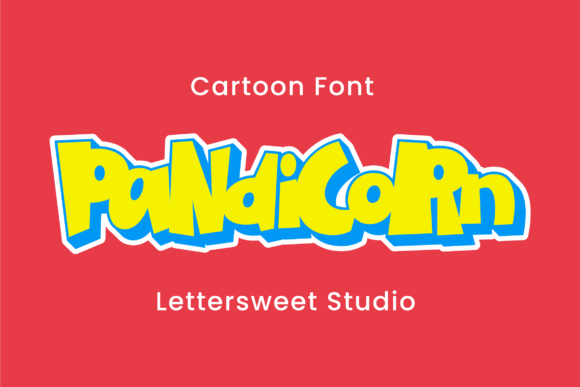
Pandicorn: A Practical Evaluation for Children's Design Projects
In the crowded landscape of digital typography, finding a typeface that genuinely resonates with a young audience while maintaining professional utility is a persistent challenge. Pandicorn emerges as a distinct solution within this niche, offering a cheerful and imaginative aesthetic specifically engineered for children's projects. Unlike generic "fun" fonts that often sacrifice legibility for whimsy, Pandicorn attempts to balance playful curves with structural integrity. For designers, educators, and content creators targeting the 0–12 demographic, understanding the practical application and limitations of this font is essential before integrating it into a production workflow.
Design Philosophy and Visual Characteristics
The core appeal of Pandicorn lies in its deliberate departure from rigid geometric sans-serifs or overly decorative scripts. The font is characterized by bold colors and rounded terminals that mimic the hand-drawn quality of children's illustrations without appearing amateurish. When evaluating a typeface for commercial use, consistency is paramount. Pandicorn maintains a high degree of character uniformity, ensuring that even when scaled down for small text elements or expanded for large headers, the weight distribution remains stable.
The "playful curves" mentioned in its design brief are not merely decorative; they serve a functional purpose in guiding the eye. In children's literature and educational materials, the shape of a letter can influence reading fluency. Pandicorn utilizes soft edges and open counters—the enclosed spaces within letters like 'o', 'e', and 'a'—to reduce visual clutter. This design choice enhances readability for early readers who may struggle with sharp angles or complex ligatures found in more traditional serif fonts. However, the boldness of the stroke weight means it requires adequate leading (line spacing) to prevent lines of text from merging visually, a factor that must be accounted for during layout design.
Color Integration and Versatility
A unique aspect of Pandicorn is its association with bold colors. While many standard OpenType fonts are delivered in black or grayscale, requiring manual recoloring in vector software, Pandicorn is often marketed with an inherent vibrancy. This feature significantly reduces the time required for branding assets where color psychology plays a crucial role. For instance, a video game developer creating a logo for a mobile app targeting preschoolers can leverage the font's built-in color variations to immediately establish a tone of excitement and wonder.
However, professionals should note that relying on pre-colored glyphs can limit flexibility in certain print environments. If a project requires strict adherence to Pantone standards or specific CMYK separations, the embedded colors may need to be flattened or overridden. Therefore, while the default presentation is effective for digital screens and quick-turnaround graphics, print designers should verify the file format compatibility to ensure color accuracy across different media.
Real-World Application and Performance
The true test of any typeface is its performance under real-world constraints. Pandicorn shines in contexts where immediate visual engagement is necessary. It is particularly effective for creating eye-catching logos, posters, and illustrations for children's products. In these scenarios, the font acts as a primary visual anchor, drawing attention faster than neutral typefaces. For example, a packaging designer working on a line of organic snacks for toddlers could use Pandicorn for the product name to signal safety and fun, distinguishing the brand from competitors using clinical, minimalist typography.
In the realm of video games, the font's robust structure holds up well against dynamic backgrounds. Game UI elements often require high contrast and instant recognition. Pandicorn's bold strokes ensure that health bars, score indicators, and dialogue boxes remain readable even amidst chaotic animation sequences. Furthermore, the font's imaginative nature aligns well with fantasy or adventure themes common in children's gaming, reinforcing the narrative without conflicting with the art style.
Despite these strengths, there are limitations to consider regarding body copy. Due to its decorative nature and varying stroke widths, Pandicorn is less suitable for long-form reading material such as novels or detailed instruction manuals. Extended use of highly stylized fonts can cause reader fatigue. Consequently, the most effective strategy is to employ Pandicorn strictly for headlines, pull quotes, and navigational elements, pairing it with a clean, neutral sans-serif for paragraphs and instructional text. This hybrid approach leverages the font's personality while preserving overall document readability.
Strategic Value for Professionals and Creators
For entrepreneurs and small business owners entering the children's market, Pandicorn offers a cost-effective way to elevate brand identity. Developing a custom typeface is a significant investment, but licensing a high-quality, specialized font like Pandicorn allows for immediate professional polish. It signals to parents and guardians that the brand understands its audience, bridging the gap between child-friendly aesthetics and adult expectations of quality.
- Educators and Publishers: Teachers creating classroom materials or publishers developing workbooks will find the font's clarity beneficial for labeling activities and highlighting key concepts. Its friendly appearance can make learning materials feel less intimidating.
- Freelance Graphic Designers: Adding Pandicorn to a toolkit provides a ready-made asset for client pitches involving kids' brands, reducing the time spent searching for appropriate typography.
- App Developers: The font's scalability makes it ideal for responsive web design and mobile interfaces where space is limited but impact is critical.
Workflow Integration and Usability
From a technical standpoint, Pandicorn integrates smoothly into standard creative suites like Adobe Illustrator, Photoshop, and InDesign. The file formats typically support standard kerning and tracking adjustments, allowing designers to fine-tune spacing for optimal composition. However, users should be aware that the playful nature of the font might require manual kerning adjustments in tight layouts, particularly around ascenders and descenders. Automated spacing algorithms sometimes struggle with highly irregular shapes, so a human touch is often necessary to achieve a polished final result.
Reliability is another key factor. A font that renders inconsistently across different operating systems or browsers can undermine a professional project. Pandicorn has demonstrated stability across major platforms, ensuring that the design intent is preserved whether viewed on a desktop monitor, a tablet, or a smartphone. This cross-platform consistency is vital for marketers running campaigns across multiple channels, ensuring brand cohesion regardless of the device used by the end-user.
Limitations and Considerations
While Pandicorn is a powerful tool, it is not a universal solution. Its distinct style makes it inappropriate for formal documents, corporate communications, or projects targeting older demographics. Using it outside of its intended context can create a tonal dissonance that undermines the credibility of the message. Additionally, because the font is designed to capture the "fun and wonder of childhood," it may age quickly if trends in children's design shift towards minimalism or realism. Long-term value depends on the timeless nature of the specific project; for evergreen products, the risk is low, but for trend-driven marketing, periodic reviews of the brand's visual identity may be necessary.
Furthermore, accessibility considerations cannot be overlooked. While the open counters aid general readability, the bold colors and specific shapes might pose challenges for individuals with certain types of color blindness or visual processing disorders. Designers aiming for inclusive products should test the font in combination with sufficient contrast ratios and consider providing alternative text options where possible.
Final Assessment
Pandicorn represents a thoughtful intersection of creativity and functionality. It successfully captures the essence of childhood through its cheerful curves and vibrant potential, making it a strong candidate for logos, posters, and interactive media. For professionals seeking to communicate warmth and imagination without sacrificing design quality, it offers significant practical value. However, its effectiveness is contingent upon appropriate usage—specifically as a display font rather than a body text solution—and careful attention to color management and spacing. By understanding both its strengths and its boundaries, creators can leverage Pandicorn to produce engaging, high-quality content that truly connects with young audiences.