Marva Bubblo Pixel: Merging Retro Charm with Modern Clarity
In the ever-evolving landscape of digital typography, designers are constantly seeking ways to bridge the gap between nostalgic aesthetics and contemporary functionality. One such innovation that has captured the attention of creatives is Marva Bubblo Pixel. This typeface represents a fascinating evolution within the Marva Bubblo Groovy font family, offering a distinct visual language that marries the organic softness of decorative bubbles with the rigid, grid-based structure of pixel art. For professionals ranging from game developers to brand strategists, understanding the nuances of this font can unlock new avenues for visual storytelling.
The Genesis of a Hybrid Aesthetic
To truly appreciate Marva Bubblo Pixel, one must first understand the design philosophy behind its creation. Traditional typography often forces a choice between legibility and style. Serifs offer elegance but can feel stiff; sans-serifs provide clarity but may lack character. Pixel fonts, while inherently retro, often struggle with readability at larger scales or in complex layouts. Conversely, bubble fonts bring a sense of fun and playfulness but can sometimes appear too cartoonish for professional applications.
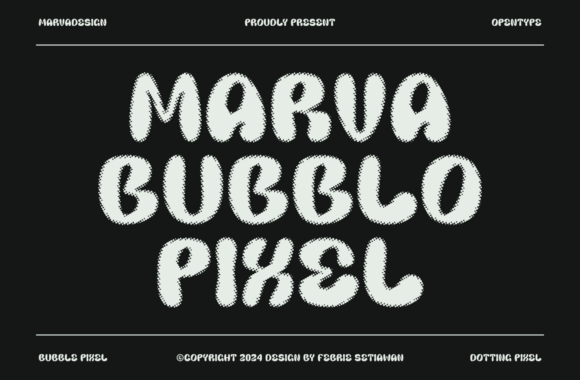
Marva Bubblo Pixel disrupts this binary by synthesizing these opposing styles. It retains the rounded, inflated contours characteristic of the original Marva Bubblo Groovy series but reinterprets them through a low-resolution, 8-bit lens. The result is a typeface where every curve is constructed from visible blocks, creating a texture that feels tactile and digital simultaneously. This hybrid approach allows the font to evoke the warmth of 1980s arcade culture while maintaining the structural integrity required for modern web and print design.
Deconstructing the Visual Elements
The core strength of this font lies in its specific construction. When analyzing the glyphs, one notices how the "bubble" aspect is not merely a shape but a mood. The rounded terminals and open counters suggest airiness and lightness. However, the application of the pixel aesthetic introduces a geometric discipline. The edges are not smooth curves but stepped approximations, which adds a layer of complexity to the visual weight of the letters.
This duality serves a practical purpose as well. In an era where screen resolution varies wildly from high-DPI mobile devices to large-format billboards, the inherent blockiness of Marva Bubblo Pixel ensures that the font remains crisp and recognizable even when scaled down significantly. Unlike vector-based bubble fonts that might blur or lose definition on lower-resolution displays, the pixelated nature of this typeface is self-consistent, preserving its intended look across all mediums.
Strategic Advantages for Creative Projects
Why choose Marva Bubblo Pixel over other retro or display fonts? The answer lies in its unique combination of advantages that cater to diverse project requirements. The primary benefit is its ability to be both decorative and attractive without sacrificing usability. The fusion of bubble elements with pixel shapes creates a style that is immediately engaging, drawing the eye with its playful yet structured appearance.
Beyond mere aesthetics, the font offers remarkable versatility. In the world of graphic design, finding a typeface that works equally well in a video game interface, a children's book cover, and a tech startup logo is rare. Marva Bubblo Pixel achieves this balance by straddling the line between whimsy and utility. Its retro-modern touch makes it an ideal choice for designs that aim to stand out in crowded digital spaces, providing a visual hook that resonates with audiences who value both nostalgia and innovation.
Enhancing Brand Identity
For business owners and marketers, typography is a critical component of brand identity. A font communicates tone before a single word is read. Marva Bubblo Pixel signals creativity, approachability, and a forward-thinking mindset rooted in history. Brands in the gaming, entertainment, and lifestyle sectors can leverage this font to establish a connection with consumers who grew up with early computing and video games. It suggests that a brand is not afraid to have fun while remaining technologically savvy.
Furthermore, the uniqueness of the font helps in differentiation. In a sea of generic sans-serif logos, a logo utilizing Marva Bubblo Pixel immediately commands attention. It breaks the monotony of standard corporate typography, offering a distinctive voice that can become synonymous with the brand itself. This is particularly valuable for startups looking to make a memorable first impression in competitive markets.
Real-World Applications and Use Cases
The practical utility of Marva Bubblo Pixel extends across a wide spectrum of creative industries. Its adaptability makes it a powerful tool for various types of projects, each benefiting from its specific stylistic traits.
- Video Game Design: Perhaps the most natural home for this font is in gaming. Whether used for title screens, HUD (Heads-Up Display) elements, or in-game signage, Marva Bubblo Pixel fits seamlessly into indie game aesthetics, retro-inspired RPGs, and casual mobile games. It enhances immersion by aligning the text with the visual style of the game world.
- Web and UI/UX Design: On the web, this font can serve as an excellent headline typeface. Its bold presence captures user attention on landing pages, while its pixelated structure ensures it renders cleanly on various devices. Designers often pair it with clean, minimalist body text to create a striking contrast that guides the user's eye effectively.
- Print Media and Posters: In the realm of print, Marva Bubblo Pixel brings a dynamic energy to posters, flyers, and event invitations. The tactile quality of the pixels translates well to paper, especially when paired with vibrant colors and bold graphics. It is particularly effective for music festivals, tech conferences, and pop-culture events.
- Logo Creation: As mentioned earlier, the font is highly suitable for logo design. Its unique silhouette allows for the creation of memorable icons and wordmarks. The combination of bubbles and pixels provides ample opportunity for customization, allowing designers to tweak specific characters to fit the brand's geometry perfectly.
Navigating Implementation Challenges
While Marva Bubblo Pixel offers numerous benefits, successful implementation requires careful consideration. Because it is a display font, it should generally be reserved for headlines, titles, and short phrases rather than long paragraphs of body text. The intricate details of the pixel structure can become visually fatiguing if used in large blocks, potentially hindering readability.
Designers must also pay attention to color pairing. The playful nature of the font pairs best with bold, saturated colors that complement its retro vibe. However, using it against busy backgrounds can reduce its impact. Ensuring sufficient contrast and whitespace around the text is crucial to maintaining its clarity and decorative appeal. Additionally, when scaling the font for different media, testing at various sizes is essential to ensure the pixelation does not become too coarse or too fine for the intended context.
Evolution of Digital Typography Trends
The rise of Marva Bubblo Pixel is not an isolated phenomenon but part of a broader trend in digital typography known as "retro-futurism." As technology advances, there is a growing appreciation for the aesthetic limitations of the past. Designers are increasingly looking back at the constraints of early computing—the limited color palettes, the blocky graphics, and the pixelated text—and reimagining them for today's high-definition world.
This trend reflects a desire for authenticity and nostalgia in an increasingly polished and homogenized digital environment. Fonts like Marva Bubblo Pixel tap into this sentiment, offering a way to connect with the cultural memory of the digital age's infancy. They remind users of a time when technology was simpler, more tangible, and often more charmingly imperfect.
Moreover, the blending of organic shapes (bubbles) with mechanical structures (pixels) mirrors the current state of human-computer interaction. We live in a world where digital experiences are becoming more fluid and intuitive, yet they remain fundamentally built on code and logic. This font visually represents that intersection, making it a relevant and timely choice for contemporary design.
Future Prospects in Creative Workflows
Looking ahead, the influence of Marva Bubblo Pixel and similar hybrid typefaces is likely to grow. As virtual reality (VR) and augmented reality (AR) technologies mature, the need for typography that can exist convincingly in 3D spaces will increase. The blocky, volumetric nature of pixel fonts lends itself well to these environments, where text often needs to appear as physical objects rather than flat overlays.
Educators and researchers studying the impact of typography on user engagement may also find value in exploring this font. Its unique characteristics could offer insights into how visual texture influences reading speed, comprehension, and emotional response. For hobbyists and independent creators, the availability of such versatile tools lowers the barrier to entry for producing high-quality, professional-looking designs.
Ultimately, Marva Bubblo Pixel stands as a testament to the creativity inherent in the design community. It challenges conventions, blends disparate styles, and offers a fresh perspective on how we communicate visually. Whether you are a seasoned professional or an aspiring creator, incorporating this font into your toolkit can add a layer of depth and personality to your work that few other typefaces can match. By embracing its retro-modern charm, designers can craft experiences that are not only visually stunning but also emotionally resonant.